Ministry of Ayush Updates List of Poisonous Substances, Adds More Minerals Under Traditional Medicine Rules
Significance for Siddha and Other Traditional Medical Systems

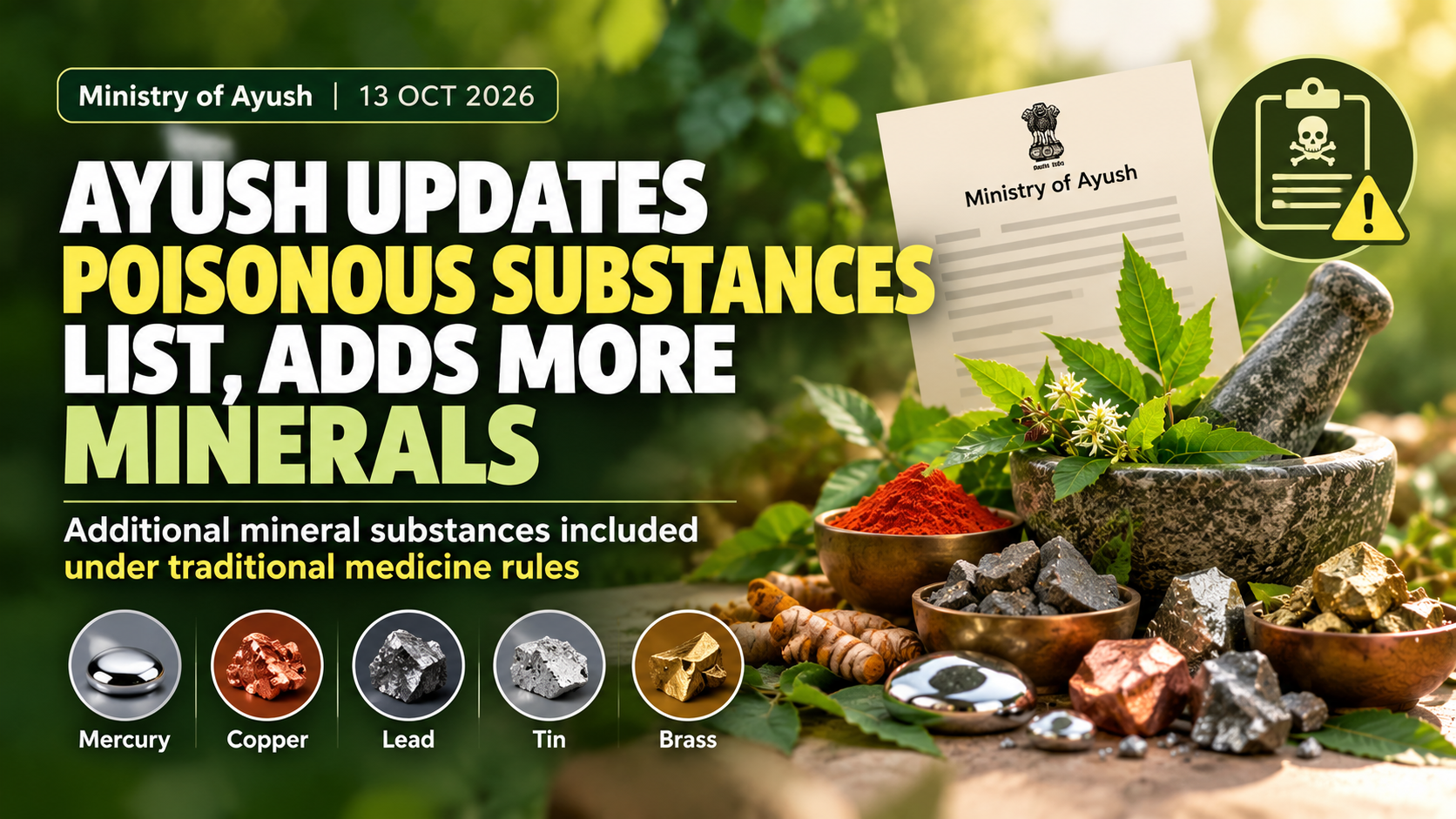
The Ministry of Ayush has updated the regulatory list of poisonous substances used in traditional systems of medicine in India, bringing additional mineral-based ingredients and expanded listings under the Drugs Rules, 1945. The amendment aims to strengthen the regulatory framework governing the manufacture, licensing and safe use of medicines containing potentially toxic substances.
The changes were introduced through the Drugs (Thirteenth Amendment) Rules, 2026, notified under G.S.R. 862(E) on September 15, 2026, and published in the Gazette of India on October 8, 2026.
What Has Changed?
The updated provisions cover substances associated with Ayurveda, Siddha, Sowa-Rigpa and Unani systems of medicine. The revised listings include minerals and metallic substances such as mercury, copper, lead, tin and brass, alongside additional entries specified in the amended rules.
These substances have historically featured in certain traditional medicinal preparations, sometimes after specialised processing. However, their potential toxicity makes appropriate preparation, quality control, dosage, labelling and medical supervision essential.
The updated list provides a regulatory reference for authorities, manufacturers and practitioners dealing with medicines that contain the specified ingredients.
Stronger Focus on Patient Safety
One of the key aspects of the regulatory framework is the requirement for appropriate safety measures when dealing with medicines containing substances listed under Schedule E(I) of the Drugs Rules.
Certain licensing requirements involve the submission of evidence relating to the safety and efficacy of the relevant medicines. The rules also prescribe warnings for internal-use medicines containing listed substances, directing patients to take them under medical supervision.
These provisions are intended to support informed use and reduce the risks associated with potentially harmful ingredients. They also reinforce the importance of following applicable manufacturing standards and regulatory requirements.
Significance for Siddha and Other Traditional Medical Systems
The amendment is relevant to practitioners and manufacturers working within Siddha, Ayurveda, Unani and Sowa-Rigpa medicine. Some traditional formulations use mineral or metallic ingredients prepared according to system-specific methods.
For Siddha medicine in particular, the development highlights the importance of maintaining traditional pharmaceutical knowledge alongside contemporary expectations for quality assurance, toxicological assessment and patient safety.
Qualified practitioners and licensed manufacturers should refer to the amended rules and applicable official guidance to understand how the changes affect their particular formulations and professional responsibilities.
A Balanced Approach to Traditional Medicine
The inclusion of a substance in a regulatory list of poisonous substances does not automatically mean that every medicine containing it is prohibited. Nor does traditional use or specialised processing, by itself, establish that a preparation is safe.
The potential risk depends on factors including the substance’s chemical form, concentration, manufacturing process, dosage, route of administration and the patient’s circumstances. Independent testing, appropriate clinical oversight and compliance with the applicable rules remain important.
Patients should avoid self-prescribing mineral-containing traditional medicines and should use them only under the supervision of appropriately qualified healthcare professionals.
Conclusion
The Ministry of Ayush’s latest regulatory update underscores the continuing importance of patient safety and quality control in India’s traditional medicine sector. By revising the list of specified poisonous substances and reinforcing relevant regulatory requirements, the amendment seeks to provide a clearer framework for the responsible manufacture and use of medicines containing potentially toxic ingredients.
For practitioners, pharmaceutical manufacturers and researchers, the next step is to examine the official notification carefully and ensure that their practices comply with the provisions applicable to their medicines.
Sources: Ministry of Ayush regulatory notification; Drugs (Thirteenth Amendment) Rules, 2026, G.S.R. 862(E), published in the Gazette of India on October 8, 2026.