Maharashtra Forms 12-Member Panel to Integrate AYUSH with Modern Medicine
IMA Raises Questions About Representation

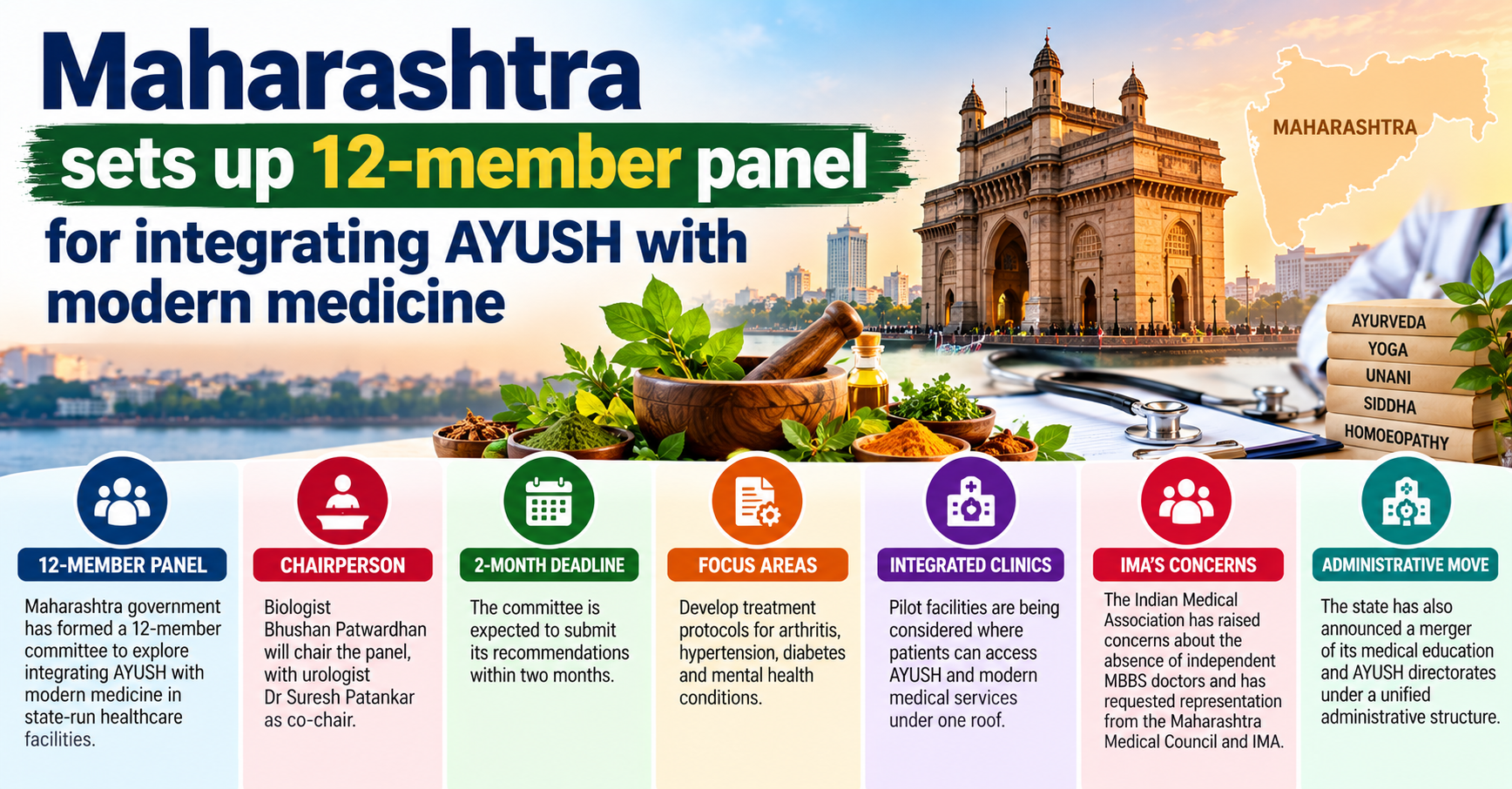
The Maharashtra government has constituted a 12-member committee to explore ways to integrate AYUSH systems of medicine with modern healthcare services in state-run medical facilities. The initiative aims to examine how traditional medical systems and contemporary clinical practices could work alongside each other within the state’s public healthcare network.
According to a report published by Medical Dialogues on October 27, the committee has been tasked with examining treatment protocols, potential integrated healthcare facilities and the practical challenges involved in implementing such a model.
The move has also triggered discussions within the medical community about clinical safety, professional representation and the need for clear guidelines governing patient care.
Committee to Examine Integration Framework
The committee will be chaired by biologist Bhushan Patwardhan, with urologist Dr Suresh Patankar serving as co-chair, according to the published report.
The panel is expected to submit its recommendations within two months. Its work will focus on developing a framework for bringing AYUSH services and modern medicine together in selected government healthcare settings.
AYUSH includes Ayurveda, Yoga and Naturopathy, Unani, Siddha and Homoeopathy. These systems already have a presence in India’s healthcare landscape, although their methods, evidence bases and appropriate clinical applications differ.
The proposed framework is expected to examine how services can be organised while maintaining appropriate standards of treatment and patient safety.
Focus on Common Health Conditions
One of the key areas under consideration is the development of treatment protocols for conditions such as arthritis, hypertension, diabetes and mental health concerns.
These conditions account for a significant share of healthcare needs and often require long-term management, regular monitoring and lifestyle modifications.
The committee’s challenge will be to determine where different approaches may complement one another, which treatments require separate clinical pathways, and how patients can be referred appropriately between practitioners.
Any proposed protocol will need to account for scientific evidence, potential interactions between treatments, contraindications and the importance of timely diagnosis.
Integrated Clinics Under Consideration
The state is also considering pilot healthcare facilities where patients could access AYUSH and modern medical services under one roof.
If implemented, such facilities could provide a coordinated point of access for consultations and referrals. Their effectiveness would depend on clearly defined professional responsibilities, appropriate staffing, reliable medical records and established procedures for emergencies.
The proposal remains at the planning and recommendation stage, and the details of any pilot programme will depend on the government’s subsequent decisions.
IMA Raises Questions About Representation
The proposed integration has drawn attention from the Indian Medical Association (IMA), which has raised concerns about the representation of modern medicine practitioners on the committee.
According to published reports, the association has sought greater representation, including participation from the Maharashtra Medical Council and IMA.
The concerns reflect a wider debate over how integrated healthcare policies should be developed. Medical professionals have emphasised the importance of transparent decision-making, clear clinical accountability and safeguards against practices that could put patients at risk.
Constructive consultation among practitioners from different systems of medicine will be important as the state develops its recommendations.
Government Restructuring Adds to the Initiative
The Maharashtra government has also announced the merger of its medical education and AYUSH directorates under a unified administrative structure, according to reports.
The restructuring is intended to bring the relevant administrative functions together. Its practical impact will depend on how responsibilities, staffing, budgets and service delivery are organised under the new arrangement.
Administrative integration, however, is distinct from clinical integration. Bringing departments together does not automatically establish that every treatment approach is suitable for every patient or medical condition.
Evidence and Patient Safety Remain Central
The proposed initiative raises an important question for public healthcare: how can different medical systems be coordinated without compromising the quality of care?
For patients, the priorities remain accurate diagnosis, appropriate treatment, informed consent and timely access to specialist services. Any integrated model must also ensure that evidence-based treatment is not delayed or replaced when it is medically necessary.
Clear guidelines, professional training, clinical oversight and outcome monitoring will be essential if the proposed framework moves forward.
What Happens Next?
The 12-member committee is expected to submit its recommendations within two months. Those recommendations should provide greater clarity on the proposed treatment protocols, the structure of integrated facilities and the concerns raised by medical associations.
The government’s subsequent decisions will determine whether pilot clinics are launched and how the proposed model is implemented across state-run healthcare facilities.
Conclusion: Maharashtra’s decision to establish a committee for integrating AYUSH with modern medicine marks a significant policy discussion for public healthcare in the state. The initiative’s success will depend on whether it produces a practical, evidence-informed framework that respects professional responsibilities and places patient safety at the centre of every clinical decision.